Arvest
Relationship mapping and deposit servicing for commercial banking, designed on the Salesforce platform.
Arvest was delivering a Business Loan Origination System and a Marketing Cloud experience on Salesforce, with KPMG and Mphasis delivery teams alongside internal design, engineering, QA and product. The recurring problem was not visual. Relationship officers think in households — one customer who brings a spouse, a business, a trust. The platform stores parties — discrete records joined by ownership. Credit and compliance need the second model and are legally bound to it. Officers need the first one to do their job.
Discover
Worked from Jira user stories and business requirements, with stakeholder interviews across relationship officers, credit, and compliance. Where requirements were ambiguous, I helped convert them back into stories the delivery teams could actually build against.
Define
Diagrammed user flows in Miro and built application maps in the Salesforce Lightning Design System. The work here was reduction: translating large, complex systems and data sets into models a person could hold in their head at the moment of a customer call.
Design
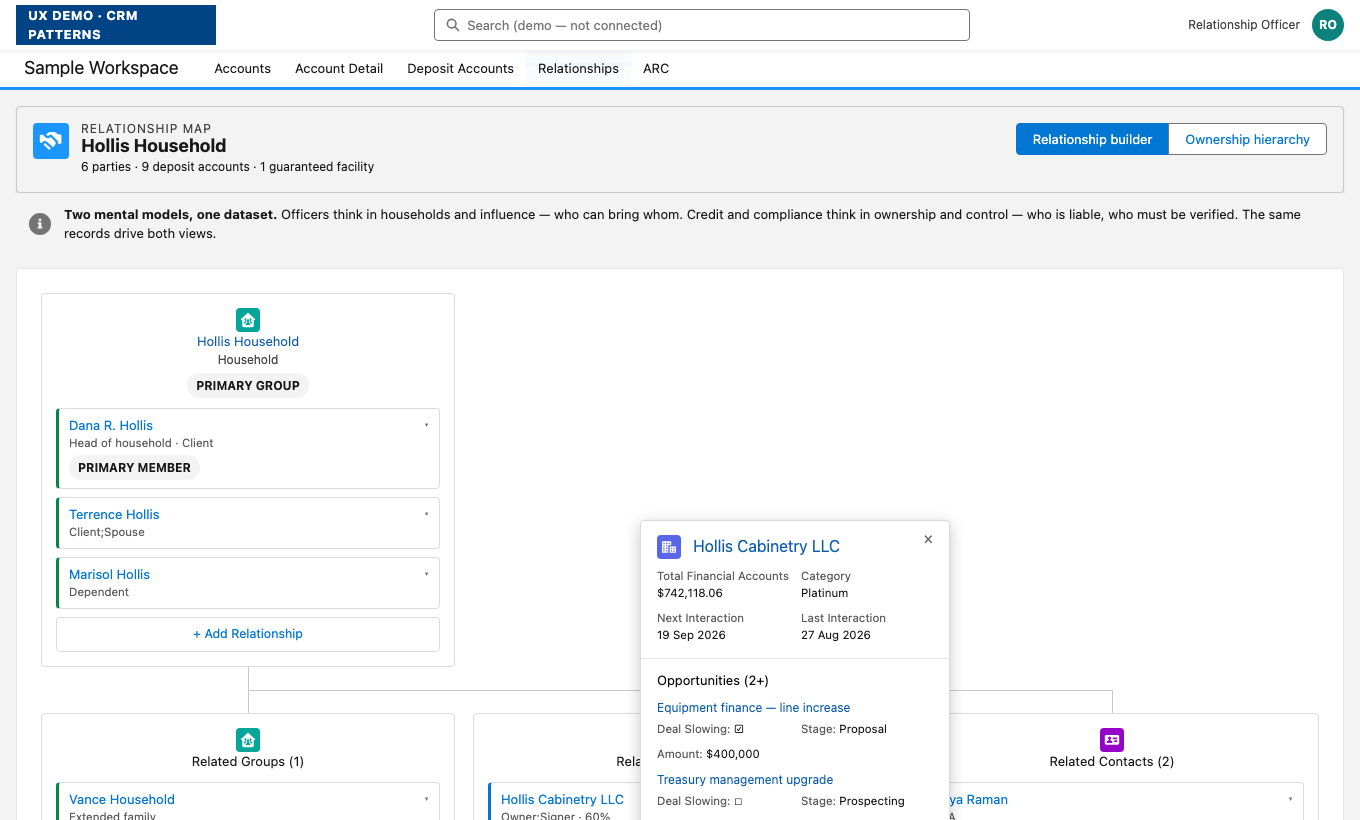
Wireframes and UI in Figma against SLDS components, following the Financial Services Cloud relationship-builder pattern: a root party, grouped branches for household, related accounts and related contacts, and a summary pop-out carrying opportunities and open service requests without leaving the map. Two views sit over one dataset — the builder for household structure and influence, an ownership hierarchy for control and liability — because forcing either audience into the other’s model produces a screen neither trusts.
Work inside compliance, not around it
Designed under bank policy, applicable law and regulation, and the bank’s BSA/AML program, completing required compliance training and internal controls. Beneficial-ownership thresholds and KYC review states are design constraints in this domain, not annotations added at the end.
Object Manager
Relationships are many-to-many — a person can own several entities, an entity can have several owners with different percentages, and roles are multi-value (Client;Spouse, Trustee;Beneficiary). That lives in a junction object carrying its own role and percentage fields, not a lookup. Reading the data model in Object Manager before designing is what keeps a relationship screen from promising a shape the schema cannot store.
Lightning App Builder
Specified record pages as component compositions — regions, component order, and visibility rules by record type — so a commercial account and a consumer account could share one page architecture without one of them carrying dead fields.
Flow
Specified guided processes as screen flows: screen order, decision branches, and what the screen does when a record is incomplete or a review has lapsed. The unhappy paths are the design work — an origination step that stalls on a missing beneficial owner is the normal case, not the exception.
Actionable Relationship Center
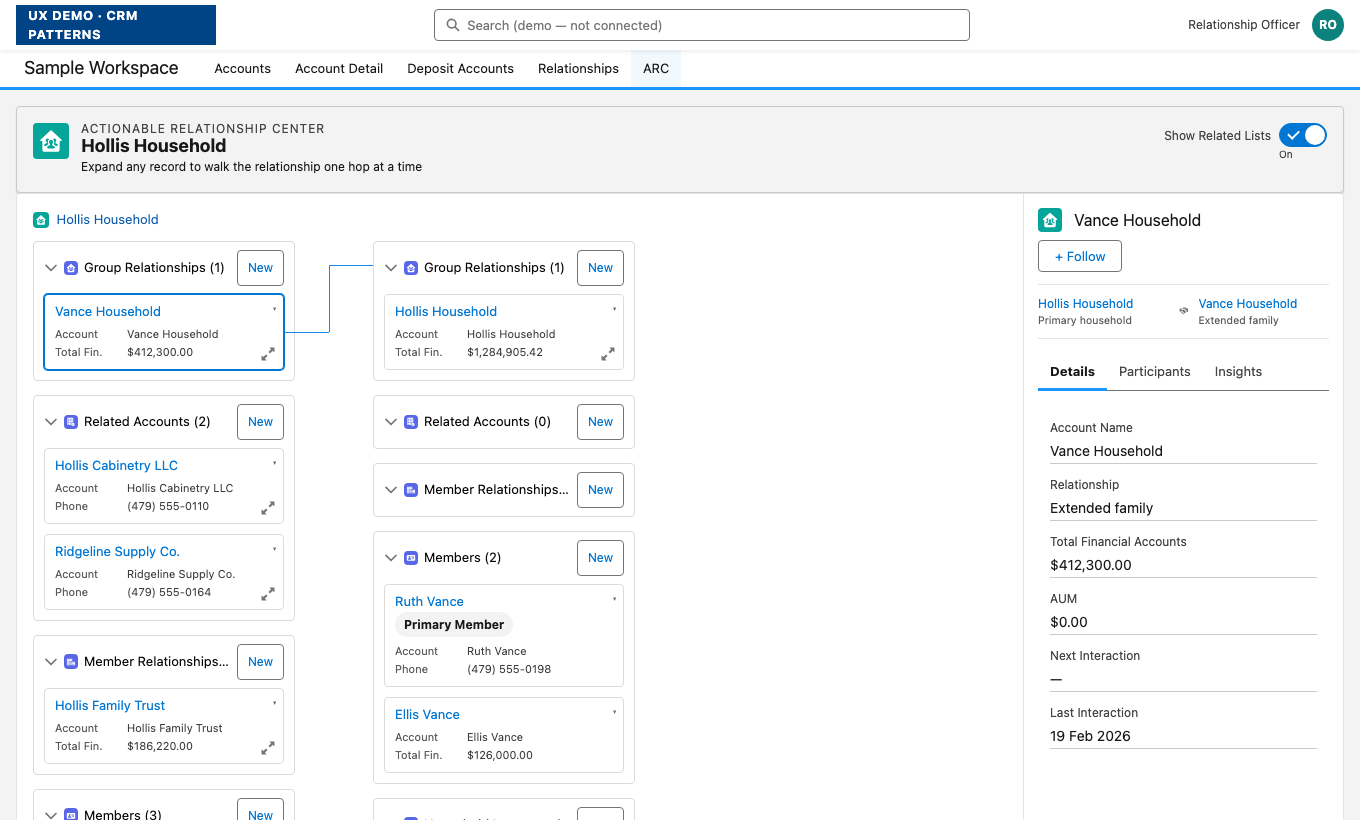
The relationship builder shows the household you already know about. ARC is for the household you don’t — expanding one record at a time until a second household, a guarantor, or an unrecorded beneficial owner surfaces. Two components over the same objects, answering opposite questions, and the reason both belong on the page.
Activity & Chatter
The right rail is where a relationship actually gets serviced — logged calls, open tasks, and the internal thread where credit tells servicing that a guarantor’s financials are stale. Designing the record page without it produces a screen that looks complete and cannot be worked from.
Marketing Cloud
Defined and prioritized opportunity areas and turned them into concepts that built a customer-relationship arc for the Marketing Cloud team — connecting what the servicing screens knew about a household to what the bank said to it.
Officers, credit, and compliance worked from the same relationship records instead of three reconciled spreadsheets — and the deposit screens stopped inflating relationship totals by counting credit limits and safe deposit boxes as deposits.
Open to senior product design roles
Remote (US hours), hybrid or onsite — full-time or contract. Happy to walk through the decisions behind any case study here.